SIMEX integrations make cell phone towers visually invisible
With SIMEX, visible cell towers become architectural elements that blend seamlessly into your buildings and the cityscape.
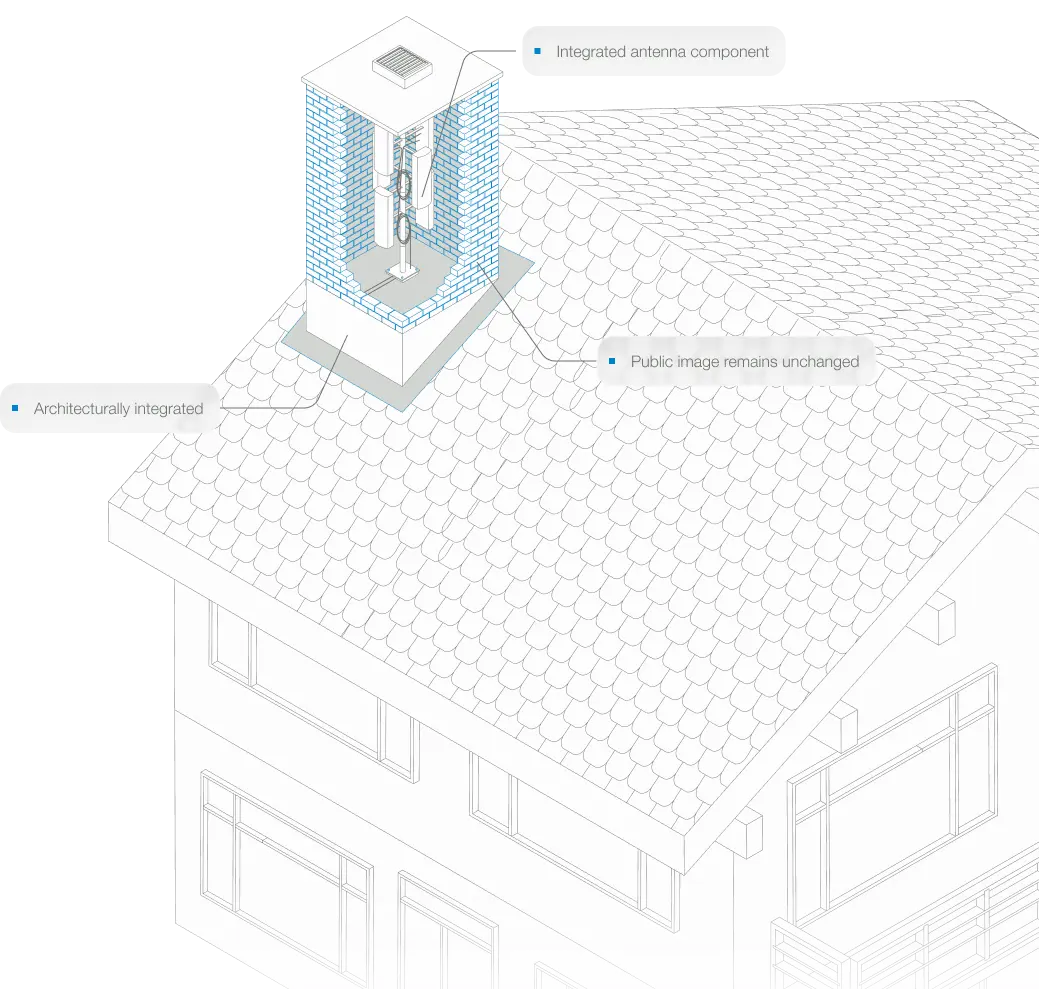
- Architecturally integrated
- Integrated Antenna Component
- Public image remains unchanged
Huge cell towers mar the appearance of your buildings and entire cities. Yet they could just as easily be hidden from view.
How? With SIMEX.
We develop integration elements made of radiation-transparent fiberglass-reinforced plastic that look like natural building components —such as chimneys, dormers, or roof structures.
The result: a harmonious cityscape and greater acceptance among residents.
When Mobile Technology Disrupts the Appearance of Buildings and Cities
Imagine a newly constructed residential or office building: high-quality materials, large windows, a harmonious overall appearance. And on top of it all, several large antenna elements rise into the sky. It’s as if someone had placed a foreign object on top of the architecture.
Or a historic old town with carefully restored facades, narrow alleys, and traditional roofs. But as soon as you look up, a cell tower catches your eye, visually disrupting the entire cityscape.
Many property management companies, real estate management firms, and municipalities know this all too well.
Mobile phone technology is necessary, but it is often disruptive and immediately draws attention:
Buildings appear less high-quality or lose their architectural appeal
Tenants find visible technology unattractive or disruptive
Especially in historic old towns, the overall appearance of an entire region suffers
That is precisely why more and more local governments and property owners are looking for ways to integrate cell towers so that they no longer stand out negatively but blend harmoniously into their surroundings.
How can cell towers be seamlessly integrated?
Imagine if cell towers no longer looked like technical structures, but rather like natural parts of a building.
No visible towers, but rather shapes that blend in seamlessly:
01
like a chimney stack that would have to be on the roof anyway,

02
like a vent pipe that isn't visually noticeable,

03
such as a roof structure that blends in with its surroundings in terms of color and texture,

04
or a component that looks exactly like the existing roof tiles or facade elements.

The result is a cityscape where cell service continues to function, but no one consciously notices the technology anymore.
- How exactly does it work? With SIMEX integrations.
Integrations for cellular networks that do not detract from the cityscape
SIMEX has been implementing mobile communications integrations for over 25 years.
Our goal: to integrate cell towers into the built environment in such a way that they continue to function fully but are no longer perceived as sources of technical interference.
Whether it’s modern new construction, residential complexes, commercial buildings, or historic city centers, our integration solutions ensure that cellular towers look like structural elements that are an integral part of the building—for example:
Masonry or facade elements
Roof tile sections or dormers
Advertising structures or neutral roof structures
Elevator or mechanical room superstructures
Chimney shafts
Ventilation Systems
The material used is glass-fiber-reinforced plastic (GFRP): UV-resistant, lightweight, easily moldable, and so radiotransparent that it was precisely measured in the laboratory to ensure it does not interfere with cellular technology.
How Integrations Work in Practice
As a property management company, you cannot make any direct structural changes to a cell tower. Those decisions are always made by the cell phone carriers or the general contractors responsible for the installation.
This is exactly where SIMEX comes in.
We not only develop the structural integration, but also coordinate it directly with the grid operators and their partners.
It’s important to note that harmonious integration is not a disadvantage for operators. On the contrary: they benefit from it because local residents raise fewer objections, leading to greater acceptance of more sites.
This facilitates the expansion of mobile networks and reduces the coordination effort required for new or existing sites.


So the result is a win-win situation
For property owners:
The building retains its appearance, and residents no longer perceive the technology as a nuisance.
For the operator:
Locations are easier to set up and operate over the long term.
For cities:
The cityscape remains intact, and cell service continues to work.
Invisible Cell Phone Antennas in 3 Steps
Step 1: Coordinate with the general contractor or utility company
We work directly with the general contractor or mobile network operator in charge to determine which integration options are technically feasible. Upon request, we can create a 3D model showing what the integrated system will look like.
Step 2: Production & Delivery
Once approved, the integration is manufactured from glass-fiber-reinforced plastic (GFRP). We handle the entire manufacturing and logistics process, ensuring that the integration components arrive ready for installation.
Step 3: Coordinating the Installation
We coordinate the installation and oversee the work. This eliminates the need for additional coordination and ensures that the installation is completed on schedule.
Here's How You Can Work with Us
Before we speak with general contractors or network operators, we first assess your situation. During an initial phone consultation, we determine which building is involved, how the mobile communications system is currently performing, and which integration options are generally feasible.
You’ll receive an initial, clear assessment: whether integration is possible, which options seem realistic, and what the process might look like for your location.
About SIMEX: Seamlessly Integrated Mobile Communication Systems
We have been developing integrations for cellular networks for over 25 years and have successfully implemented them at more than 1,500 sites during that time.
What began in Switzerland many years ago is now an internationally adopted approach: designing mobile communications technology so that it continues to function fully but is not perceived as a technical installation.
Thanks to hundreds of projects in historic old towns, residential neighborhoods, modern new buildings, and commercial structures, we know exactly which designs are suitable for which types of architecture, how integrations must be engineered, and how they are technically approved.
From Switzerland for projects throughout Europe
SIMEXgroup is headquartered in the Appenzell region of Switzerland. This is where we develop and design our integration solutions. The components are manufactured at certified partner facilities in France and Germany. We implement these integration solutions throughout Europe.
Frequently Asked Questions About Integrating Mobile Communication Systems with SIMEX
Visible cell towers often look out of place on roofs or facades and detract from the appearance of a building or the entire cityscape. Integration ensures that the technology is visually incorporated into the architecture without compromising its function. This leads to greater acceptance among residents and property owners and reduces disputes regarding new or existing locations.
During integration, the cellular network is supplemented with components that blend in seamlessly with the roof or facade. The cladding is made of radio-transparent fiberglass-reinforced plastic (FRP) so that the equipment can continue to transmit without signal loss. Depending on the building’s shape, the integration is designed to resemble a chimney flue, a dormer, a ventilation structure, or a facade element.
In most cases, yes. The key factors are the building’s structural conditions, the operator’s technology, and the available space on the roof or facade. Thanks to the freely moldable GRP elements, virtually any building design can be accommodated—from modern buildings to historic structures. We determine whether integration is possible in consultation with the responsible general contractor or utility provider.
The design is based on the building’s architecture and the technical requirements of the cellular network. Possible options include chimney shafts, roof structures, dormers, ventilation elements, and facade components. The goal is for the integration to appear as a natural part of the building and to blend in seamlessly with the surrounding structure.
The final decision always rests with the mobile network operators or the general contractors carrying out the network expansion. As a property manager or owner, you cannot make any structural changes to the facility yourself.
However, you do have some influence over existing or new site agreements:
For many rooftop sites, there are long-term agreements (e.g., over ten years) between the owner and the operator. In such cases, the owner may make the renewal or amendment of the agreement contingent on the system being structurally integrated.
Even for new buildings or newly planned locations, integration can be specified as a requirement from the outset. Since operators rely on functional locations and need to move forward with expansion, they often agree to this.
SIMEX therefore coordinates the integration solution directly with the responsible partners and ensures that the implementation is approved from both a technical and organizational standpoint.
Once the variant has been selected and approved, the production time is typically about 4–5 weeks. The components are then delivered and installed.
Yes. Since the elements can be freely shaped and adapted in terms of color and texture to match existing roof or facade areas, they can also be integrated into sensitive or historic settings. In such cases, the design is chosen with particular care to ensure that it blends well with the historic surroundings.
It is important to obtain the appropriate permit from the relevant authorities, which is mandatory for buildings designated as historic landmarks.