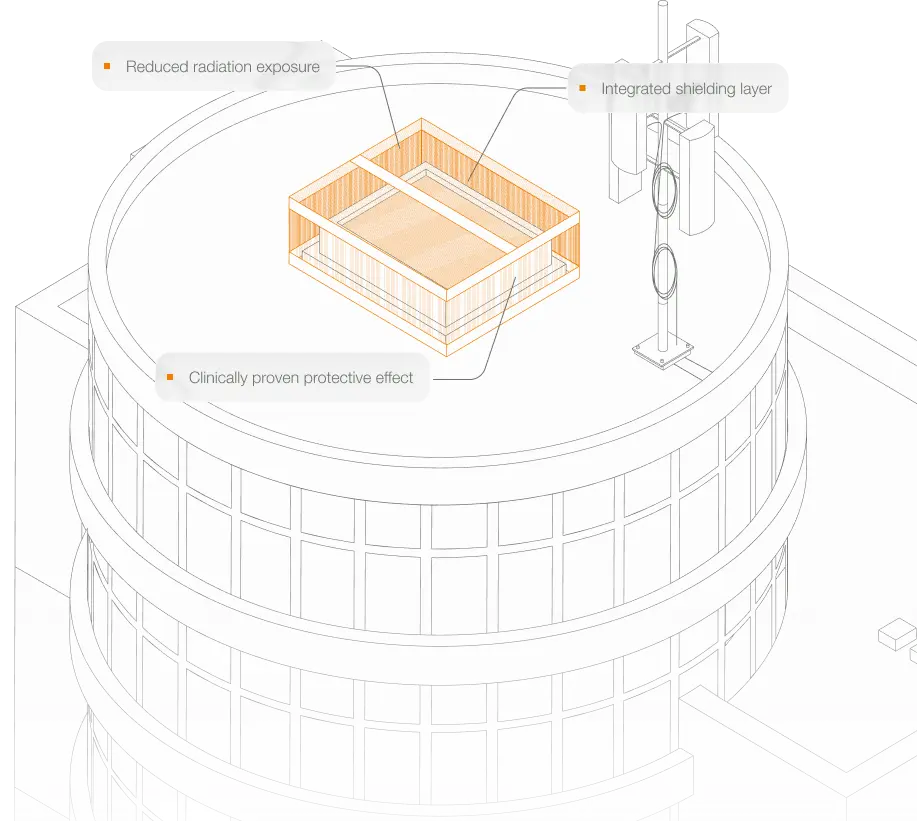
With SIMEX shielding, you can protect the spaces where you live and work from cell phone radiation
Windows, skylights, or lightweight structural elements often allow more radiation to pass through than expected. We identify the relevant entry points and install effective shielding according to technical standards.
- Reduced radiation exposure
- Integrated shielding layer
- Clinically demonstrated protective effect
Do you want to protect your building from the radiation emitted by cell networks?
Be aware: If work is performed in the wrong place or the wrong material is used, the protective measures will have no effect.
At SIMEX, that’s why we analyse which areas are affected and how shielding would make a difference in your specific case. Then we take care of the implementation. A final measurement conducted by an external provider shows how much the radiation was reduced.
Is there a cell phone tower nearby?
This also means that more and more people are living in the immediate vicinity of active transmission towers.
As a result, many homeowners and property owners are increasingly wondering to what extent their living spaces are affected:
- Are attic bedrooms in the direct radiation zone?
- Do skylights or lightweight building components allow radiation to pass through unimpeded?
- Will tenants complain about a nearby antenna?
Some countries – such as Switzerland – even set clear limits that must be observed in living spaces near cell towers.
This shows that radiation exposure is an issue that must be taken seriously.
And this is precisely where the crucial question arises for homeowners: How can living spaces be reliably protected?
How to protect your property from cell phone radiation
There are various ways to shield living spaces from incoming radiation. Depending on the building’s construction, window areas, and distance from the antenna, different materials and measures may be appropriate.
01
Shielding films: for glass surfaces, skylights, and large window walls.

02
Shielding nets: for roof surfaces, skylights, or areas with lightweight materials.

03
Shielding cages: for skylights or roof windows that are located directly within the radiation field.

04
Shielding paints: for interior or exterior walls, ceilings, and roof surfaces when certain areas need to be protected.

These materials work on the same principle:
- They absorb, reflect, or limit the radiation.
Important to note: Proper application is crucial
A common mistake: Many homeowners order products online and install them themselves—without making sure that
- the area being treated is the main entry point for the radiation
- the material is suitable for the specific structure
- the measures will help the building be approved more quickly
The result is always the same: The radiation remains virtually unchanged, and the investment goes to waste.
For shielding to be truly effective, four factors have to come together:
A precise analysis
Choosing the right material
for the respective component.
Installation according to technical standards
by an experienced professional.
A final measurement
to confirm the reduction in radiation exposure.
Professional shielding for your building with SIMEX
At SIMEX, we’ve been providing shielding solutions for living spaces and common areas for over 10 years.
Because we are based in Switzerland, we addressed this issue long ago – since clear exposure limits have been established here for many years, and compliance is mandatory for the expansion of mobile networks.
Thanks to this experience, we know exactly which shielding works in which situation, how it should be installed, and which materials are suitable for which components.
To ensure effective shielding, we analyse where and how radiation enters your building. Based on this assessment, we recommend the appropriate material and coordinate its proper installation. A final measurement conducted by an external provider then confirms the reduction in radiation exposure.
Your benefits with SIMEX:
- Demonstrably lower radiation levels in living areas
- Safety, as all measures have been technically reviewed
- Eliminated risk of unneeded purchase or incorrect product use
- Easy integration even in new construction
Shielding for your building in 4 steps
Step 1: Initial analysis
Using photographs and documentation drawings, we determine which components are affected – such as skylights, transom windows, or roof surfaces.
Step 2: Selecting the appropriate shielding materials
Based on the analysis, we determine which measures are appropriate in which areas and place an order for them.
Step 3: Proper installation
The shielding is installed. We organise the entire installation process and coordinate the contractors carrying out the work.
Step 4: Measurement and review of results
After implementation, an external provider will measure the radiation levels. This will give you a reliable basis value.
Here's how you can work with us
Are you interested in shielding solutions? During your initial consultation
, you’ll receive an assessment of which measures might be appropriate for your situation.
About SIMEX
We are based in Switzerland. Mandatory exposure limits for cell phone towers have been in effect here for many years, which is why we began specialising in shielding early on.
In numerous projects, we have ensured that cell phone towers were installed while radiation levels in nearby residential areas remained below the specified limits.
Over the years, we have developed a deep understanding of where radiation enters buildings, which building components are critical, and how shielding must be designed to be effective.
Today, we would like to apply this expertise not only in Switzerland, but also in Austria and Germany.
Frequently asked questions about shielding against cell phone radiation
Whether and to what extent cell phone radiation penetrates a building depends not only on the distance from the antenna, but also on skylights, roof windows, walls built of lightweight materials, or the building’s orientation. During the initial consultation, we’ll identify which areas might be relevant. An accurate assessment can only be made on-site at the building, where we can see where the radiation is actually entering and which building components are affected.
The most common examples are components with thin walls: skylights, roof domes, thin roof surfaces, or lightweight wall structures. Glass surfaces also play a major role, as they provide little protection against radiation.
Depending on the situation, various materials may be suitable: shielding films for glass surfaces, shielding nets for roof surfaces or skylights, shielding baskets for light domes, and shielding paints. Which method is most effective depends on where the radiation enters and how the structural components are designed. Effective shielding is the result of a combination of expert analysis, the right material, and professional installation.
In theory, yes – but in practice, this often leads to incorrect application. Without knowing in advance which area actually needs to be shielded, a measure loses its effectiveness. In addition, materials must be handed correctly from a technical standpoint and, in some cases, meet specific requirements. That’s why it’s always advisable to seek an expert assessment before using any products.
Yes. This is a crucial component of any shielding measure. External testing firms have the appropriate equipment and software systems for this and can perform the necessary analysis and calculations.
Yes. In fact, it works particularly well. During the planning phase, suitable materials can be incorporated directly, without having to open up or modify components later on. This allows critical areas to be protected from the very beginning – for example, roof surfaces, window areas, or skylights.
Your home Wi-Fi is generally not affected by shielding, since it is provided through your router and internal wiring. These measures are intended solely to block external cellular radiation – that is, signals that penetrate the building from outside.
The cost depends heavily on which components are affected and how large the affected areas are. The type of material also plays a role. You can get a cost estimate during an initial phone consultation.
Mobile phone radiation is a type of non-ionising radiation (NIR). It consists of electromagnetic waves with relatively long wavelengths and low energy. This means that this radiation cannot ionise atoms or molecules and therefore cannot cause direct damage to cells or DNA, as would be the case with X-rays, for example.