- Masts, platforms, and cladding for mobile network expansion
As sturdy as steel. More cost-effective to install. Maintenance-free in operation.
SIMEX develops, manufactures, and supplies hybrid structures made of steel and fiberglass-reinforced plastic (FRP) for your cellular towers. You’ll save on material, installation, and maintenance costs.
You are currently viewing a placeholder content from Default. To access the actual content, click the button below. Please note that doing so will share data with third-party providers.
More Information- The biggest cost driver for general contractors in mobile network expansion: steel—expensive to purchase, time-consuming to install, and requiring frequent maintenance.
- But steel is essential for providing the necessary stability, isn't it? That's right. But it can be combined effectively with other materials.
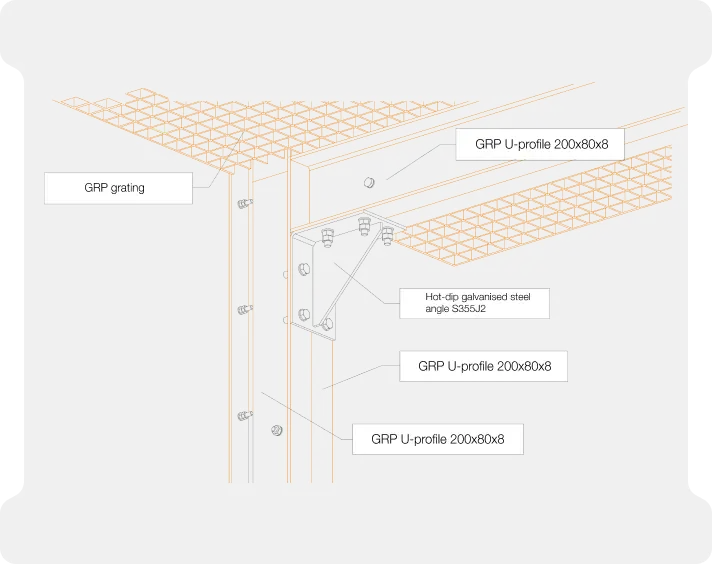
- With SIMEX's hybrid designs, we use steel only where it is structurally necessary. All other components are made of corrosion-resistant glass-fiber-reinforced plastic (GFRP).
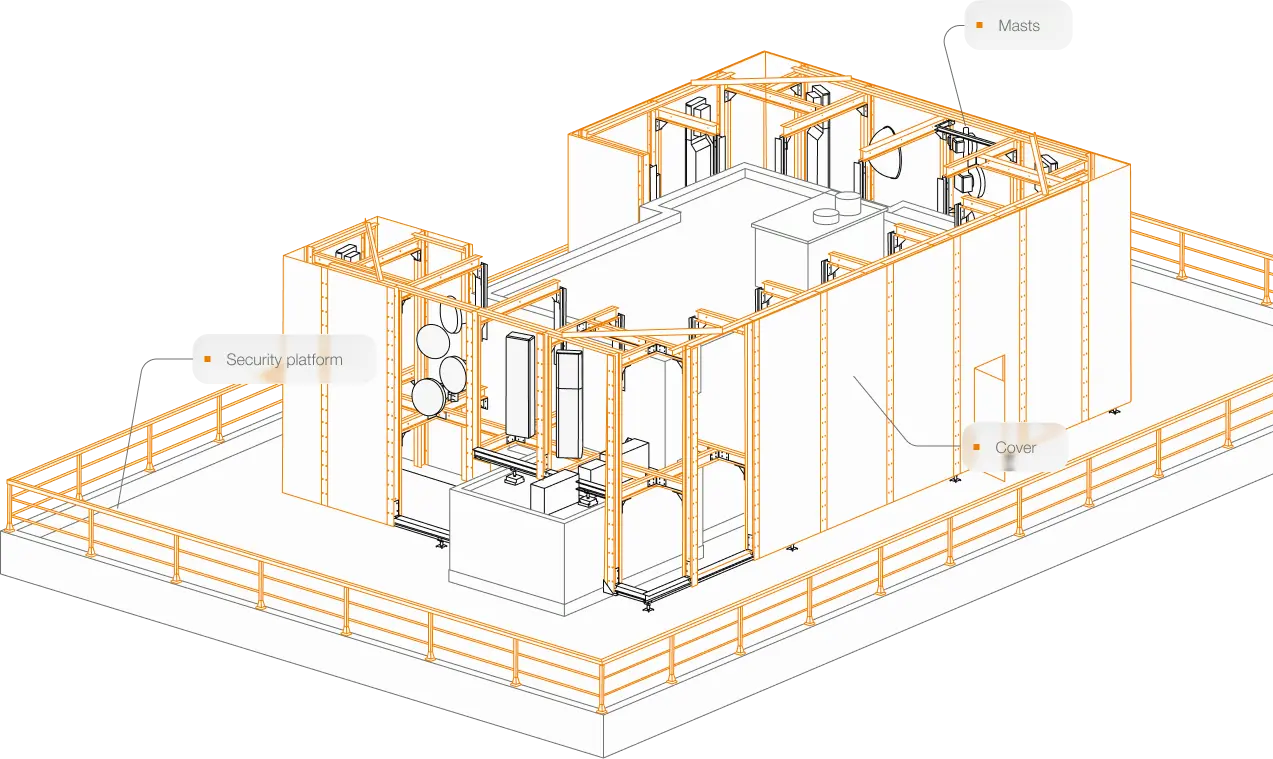
- The result: Poles, platforms, railings, and cladding are less expensive to purchase, can be installed more quickly, and thus reduce overall costs.
Practical Experience with Our Hybrid Designs
“The hybrid design could be installed without any modifications. The reduced complexity significantly shortened the installation time.”
“As one of the first users of a hybrid design, I was skeptical at first. However, thanks to careful planning and thorough structural analysis, the project went off without a hitch, and we stayed within budget.”
“The combination of steel and composite materials proved to be technically and economically sound. The hybrid solution met all structural requirements while using significantly fewer resources.”
“The hybrid design could be installed without any modifications. The reduced complexity significantly shortened the installation time.”
“As one of the first users of a hybrid design, I was skeptical at first. However, thanks to careful planning and thorough structural analysis, the project went off without a hitch, and we stayed within budget.”
“The combination of steel and composite materials proved to be technically and economically sound. The hybrid solution met all structural requirements while using significantly fewer resources.”
The Biggest Cost Trap in the Construction of Cell Towers
Whether it’s towers, platforms, railings, or covers: wherever mobile communications technology is installed, one material has been used above all others so far: steel.
The problem: Steel results in high costs at every stage of a project
In production, because its manufacture requires enormous amounts of energy.
During installation, because it requires more installers, longer construction times, and the use of a crane for several days.
During maintenance, because steel must be regularly inspected for rust and recoated.
During transport, because the weight and size of the components require special vehicles and complex delivery arrangements.
And even when it comes to cost estimates, because fluctuating raw material prices make it difficult to plan any project.
However, steel is virtually indispensable for the expansion of mobile networks. This is because it is extremely sturdy, meets all safety requirements, and can withstand even high winds and heavy loads.
As sturdy as steel, but without the high cost. Is that possible?
When stability is essential but costs are increasingly becoming the deciding factor, the question arises: What would a system that can deliver both look like?
A system that combines the strength of steel with the lightness and cost-effectiveness of modern materials.
Imagine using a material for cell phone network expansion that …
01
is so strong that it can withstand the same loads as steel,
02
is significantly lighter and can be installed without having to use a crane for days on end,
03
is corrosion-free and therefore requires little maintenance,
04
remains dimensionally stable in all weather conditions,
05
and whose costs can be reliably estimated from the very beginning.
- This is possible with SIMEX's hybrid designs.
Steel vs.
FRP vs.
Hybrid Structures
by SIMEX
Steel structures offer high load-bearing capacity, but they are expensive to manufacture and require significant effort for maintenance and installation.
FRP structures are significantly lighter and corrosion-free, but they reach their limits when subjected to heavy loads.
SIMEX hybrid structures combine the strength of steel with the lightness and durability of fiberglass-reinforced plastic (FRP). Because of their lower weight, they place less stress on the underlying structure.
A Comparison of the 3 Designs:
| Steel Structures | FRP | Hybrid Structures by SIMEX | |
|---|---|---|---|
| Sufficient stability | |||
| Less installation effort | |||
| Lower costs | |||
| Lightweight |
Steel Structures
GFRP
Hybrid Structures from SIMEX
Hybrid Structures from SIMEX:
Lighter weight, shorter construction time, same stability
With SIMEX's hybrid designs—
—you can connect …
… the strength of steel —for proven load-bearing capacity and safety under any load.
… with the lightness of fiberglass-reinforced plastic (FRP) for easier logistics, lower weight, and faster assembly.
… and combine the two into a statically tested system that is easier to use, durable, maintenance-free, and, above all, more affordable.
In other words, you save money by …
… reduce material costs.
Unlike steel, GRP does not require an energy-intensive melting process. This reduces energy consumption during production and, consequently, material costs.
… lift less weight.
FRP components are significantly lighter than steel. As a result, transportation, delivery, and handling can be completed more quickly, at a lower cost, and with fewer staff.
… plan for just one day of crane time instead of a whole week.
The pre-assembled modules are placed in a single lift. This means the crane only needs to be used for one day, rather than remaining on the construction site for several days. This significantly reduces rental and labor costs.
… do not require any follow-up work or maintenance.
FRP does not rust, requires no coating, and retains its shape. This saves on materials, time, and recurring maintenance costs.
… to better plan materials and construction schedules .
Thanks to 3D planning and pre-assembled delivery, all components are precisely prepared. This prevents the need for rework on the construction site and ensures that operations run smoothly.
The result: You save money at every step throughout the entire lifecycle.
Already successfully in use at more than 1,000 locations across Europe
Here's How Your Project Will Proceed with SIMEX
Step 1: Design & 3D Model
We create a 3D model, perform structural analyses, and develop and design your hybrid structure. You will then receive a quote with all the technical details.
Step 2: Order & Approval
Once you approve it, the project will move on to the technical coordination phase. All materials, dimensions, and deadlines will be finalized and documented.
Step 3: Production & Pre-assembly
The components are manufactured, inspected, and pre-assembled. Steel and fiberglass-reinforced plastic (FRP) elements are combined so that everything can be delivered ready for installation.
Step 4: Delivery & Installation Coordination
The pre-assembled modules are delivered and installed on-site in a single step. SIMEX coordinates the installation and ensures that everything is completed on schedule.
Get your project started at with SIMEX
Would you like to know if hybrid designs are suitable for your project?
Then start with a free initial consultation. During a joint Teams meeting, we’ll walk you through the system in detail, show you reference projects, and explore how the concept can be best integrated into your construction project.
The result of more than 15 years of materials , and design development
There’s more to SIMEX’s hybrid designs than just a new idea. They are the result of over
15 years of experience in the development and manufacture of technical structures for extreme conditions.
The concept originally comes from the offshore sector, where steel and glass-fiber-reinforced plastic (GFRP) have been used together for years—in environments where materials must withstand wind, salt, moisture, and UV radiation day in and day out.
We want to apply the solutions that have proven effective there to mobile communications on land as well: hybrid structures that remain as sturdy as steel but are lighter, corrosion-free, and durable.
Our systems are now in use at over 1,000 locations across Europe —on roofs, masts, and platforms. Every structure is designed, tested, and manufactured in-house at SIMEX.
Development in Switzerland for projects throughout Europe
SIMEXgroup is headquartered in the Appenzell region, where development and design take place. Production is carried out at certified partner facilities in France and Germany.
However, projects are also carried out across Europe. Communication and project coordination take place digitally via Microsoft Teams.
's Frequently Asked Questions About SIMEX Hybrid Structures
Hybrid structures combine steel elements with components made of glass-fiber-reinforced plastic (GFRP). Steel provides the necessary stability, while GFRP ensures lower weight, corrosion resistance, and easy assembly. The result is a structure that is just as stable as all-steel structures, but lighter, maintenance-free, and more cost-effective in the long term. Each hybrid structure is designed for its specific location, digitally modeled, structurally analyzed, and manufactured in our own production facility.
Since steel and fiberglass-reinforced plastic (FRP) have similar coefficients of thermal expansion, both materials behave almost identically in response to temperature changes. This makes them particularly well-suited for use together in structural applications.
SIMEX hybrid solutions are used wherever high load-bearing capacity combined with low weight is required—for example, for:
- Poles (of low height),
- Roof-mounted platforms for cellular communication systems,
- Railing and Access Systems,
- Equipment platforms or
- Covers around the antenna site.
The system is also particularly well-suited for existing buildings where load-bearing capacities are limited.
After the initial consultation, SIMEX handles all technical planning:
- Design and 3D model based on the project data,
- Structural analysis of all components,
- Consultation and Proposal,
- Production, pre-assembly, and delivery.
The result is a fully planned and documented system that simply needs to be assembled and installed on the construction site.
Design is performed in accordance with DIN EN 13706 and in accordance with the principles set forth in EN 1990 (Eurocode 0) for safety and reliability. The steel parts ensure stability, while the GRP components provide lightness and weather resistance. Each structure undergoes structural analysis and is reviewed on a project-by-project basis —ensuring that it reliably meets all load requirements (e.g., wind loads and point loads).
FRP components weigh less than half as much as steel, which makes the entire structure significantly lighter. In practice, this means that transportation, delivery, and installation are easier, and the components can often be moved using smaller equipment.
Once technical approval has been granted, production typically takes 4 to 5 weeks. During this time, all components are manufactured, tested, and pre-assembled so that the system can be delivered ready for installation. The system is then installed in a single step.
None on the structures themselves. The GRP components are corrosion-free, UV-resistant, and dimensionally stable. Neither recoating nor regular inspections for corrosion are required. The structures remain permanently functional—even under continuous exposure to the elements, as is typical in the mobile communications sector.
Hybrid designs have a positive impact on overall costs in several phases.
Even during production, less effort is required because GRP is manufactured without energy-intensive melting processes. This reduces material and manufacturing costs.
Installation is significantly less labor-intensive because many components are delivered pre-assembled and the structure is lighter. This results in shorter construction times and reduced staffing requirements.
GRP components require no maintenance during operation: there is no rust, no need for recoating, and no regular inspection intervals. This reduces operating costs over many years.
Overall, this results in a system that is significantly more cost-effective than all-steel structures in all project phases—from manufacturing to operation.
Yes. SIMEX has already implemented over 1,000 hybrid structures across Europeon rooftops, masts, and technical platforms. You can find various reference projects on our website. We’d be happy to show you even more application areas during a consultation.
Their service life is at least as long as that of comparable steel structures—and is often significantly longer, because GRP does not corrode and therefore does not require recoating. SIMEX structures are designed for a service life of over 25 years.
While pure FRP systems are very lightweight and corrosion-resistant, they reach their limits when subjected to heavy loads. SIMEX hybrid structures solve this problem by intelligently combining steel and FRP —resulting in a system that combines the best of both worlds: full structural stability with significantly lower weight.
The structures are modular in design. This means that expansions or modifications can be easily implemented using new modules or connection points. Retrofitting is also possible without any problems and without having to dismantle the entire structure.